
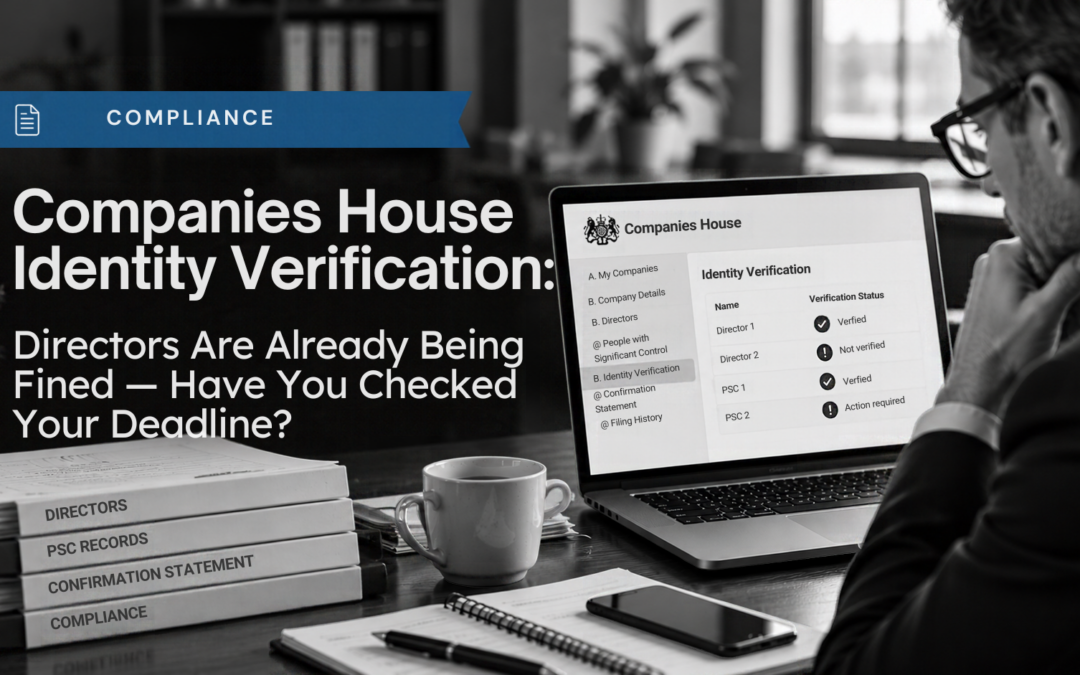
Companies House identity verification is no longer something sitting on the horizon.
The new requirements have been compulsory since 18 November 2025, the first directors have now been prosecuted for identity-verification offences, and the 12-month transition period for existing directors and people with significant control (PSCs) is approaching its end.
For company owners, this is therefore a good time to check that everyone who needs to act has actually done so.
Directors Have Already Been Prosecuted
On 17 September 2026, the Insolvency Service and Companies House announced the first successful prosecutions involving the new identity-verification requirements.
Three directors were fined following court action.
One director had continued acting without completing her identity verification. Another had verified his own identity but was prosecuted after failing to take reasonable steps to prevent an unverified fellow director from continuing to act.
That second point is particularly important.
Identity verification is not simply an administrative exercise that each director can safely assume is somebody else’s responsibility. Companies and their directors also need to ensure that people acting as directors comply with the requirements.
What Do Existing Directors Need to Do?
If you were already a director before 18 November 2025, you generally need to:
- verify your identity;
- obtain your Companies House personal code; and
- provide that code for each relevant directorship as required.
Existing directors are required to provide their verification details alongside the company’s next confirmation statement during the transition arrangements.
Your personal code belongs to you, rather than to a particular company.
So if you are a director of several companies, you normally verify your identity once and use the same personal code for each appointment. The code still needs to be connected to each relevant directorship.
A familiar business moment
Director: “Our accountant files the confirmation statement, so I assumed they had done my identity verification.”
Accountant: “We assumed you had verified yourself and sent us your personal code.”
And suddenly everyone is looking at the filing deadline.
The important point is that using an accountant to deal with Companies House filings does not, by itself, mean that your personal verification obligations have been completed.
Is 18 November 2026 the Deadline?
Not necessarily.
This is an area where headlines can be misleading.
18 November 2026 marks the end of the 12-month transition period. It should not be treated as one universal deadline applying to every director on the same day.
For an existing director, the relevant timing is generally linked to the company’s confirmation statement during the transition period.
Companies House itself describes 18 November 2025 as the start, rather than the deadline, for the transition arrangements.
Businesses should therefore check their own position rather than simply putting 18 November 2026 in the diary and assuming there is nothing to do until then.
What About People With Significant Control?
PSCs have identity-verification obligations too, but the process and timing are not necessarily identical to those for directors.
A PSC generally has a specific 14-day period in which their personal code and verification statement must be provided.
For somebody who was already a PSC when mandatory verification began, the relevant dates depend partly on whether they are also a director of the company.
This makes it particularly important for owner-managed companies where an individual may be both a director and PSC to check that both roles have been dealt with correctly.
A familiar business moment
“I’ve verified my identity, so that’s finished.”
Possibly.
But if you own several companies, hold several directorships and are also recorded as a PSC, being verified and connecting that verification to all the places it is required are not quite the same thing.
What Happens If You Do Nothing?
Companies House warns that failure to comply with identity-verification requirements can constitute an offence.
Possible consequences include prosecution, court fines or financial penalties.
An unverified person may also be prevented from being appointed as a new director or registering a new company, and Companies House intends to place information about non-compliance on the public register.
A company may also be unable to file its confirmation statement if its directors have not met the required verification requirements.
What Should Company Owners Check Now?
We would suggest asking five simple questions:
- Have all directors verified their identity?
- Does each director have their Companies House personal code?
- Has that code been provided for every relevant directorship?
- Are any directors also PSCs, with separate requirements to deal with?
- When is the company’s next confirmation statement due?
It is also worth checking that names, dates of birth and other personal details held by Companies House are correct. Differences in records can create problems when verification details are connected.
Our view
Companies House identity verification should now form part of normal company administration rather than being viewed as a one-off exercise.
For many owner-managed businesses, the greatest risk is probably not a deliberate decision to ignore the rules. It is assumption.
The director assumes the accountant has dealt with it. The accountant assumes the director has completed their personal verification. Or somebody has verified their identity but has not realised there is another step required for a separate directorship or PSC position.
The first prosecutions demonstrate that Companies House and the Insolvency Service are prepared to enforce the new regime.
We would therefore encourage directors to check their position now, while there is still time to correct missing information or resolve mismatched records without the pressure of an imminent filing deadline.
About this article
Written by: We Are Pi Chartered Certified Accountants
Reviewed by: Angelique Wright FCCA
Last reviewed: 18 October 2026
Sources and further guidance:
- Companies House / GOV.UK guidance on when directors and PSCs must verify their identity;
- Companies House / GOV.UK guidance on Companies House personal codes for identity verification;
- Companies House / GOV.UK guidance on filing a company’s confirmation statement;
- Companies House / GOV.UK guidance on non-compliance with mandatory identity verification;
- the Insolvency Service and Companies House enforcement announcement dated 17 September 2026 concerning the first successful prosecutions; and
- the Economic Crime and Corporate Transparency Act 2023 (Commencement No. 6 and Transitional Provisions) Regulations 2025, which set out the commencement and transition arrangements.
All sources used for the substantive regulatory points in this article are official UK Government, Companies House, Insolvency Service or legislation sources.
About We Are Pi
We Are Pi is a Buckinghamshire-based firm of Chartered Certified Accountants supporting owner-managed businesses, company directors and individuals with accounting, tax, compliance and business advisory services.
Important information: This article is intended for general information only and should not be treated as legal, accounting or other professional advice specific to your circumstances. Companies House requirements depend upon an individual’s roles and circumstances, and legislation and guidance can change.
Would you like to check that your Companies House records and identity-verification requirements are up to date?
We Are Pi can help review your company information, confirmation-statement position and director and PSC records, and identify where further Companies House action may be required.
Recent Comments